
Every parent I talk to knows this story. Their kid knows the material, they can explain it out loud — but the homework still doesn't get started. Or gets started and abandoned. Or gets finished and never makes it into the backpack. Knowing something and doing something with it turn out to be two separate problems.
The doing part has a name. Executive functions (EF) are the cognitive processes that drive goal-directed behavior: the mental machinery that lets a person keep a goal in mind, plan a way to achieve it, resist the things that would deter them from the goal, and keep going when it gets hard or uninteresting.
The brain's air traffic control system
The Center on the Developing Child at Harvard likens EF processes to the brain's "air traffic control system." A controller isn't flying any of the planes. Their job is deciding what lands, in what order, what circles, and what gets rerouted when something changes, all while a dozen other things are happening on the radar at once.
What students do in their schoolwork is pretty similar. A student writing an essay is holding a thesis in mind (working memory), deciding which of five quotes actually supports it (planning), noticing that a paragraph drifted off-topic (self-monitoring), and staying in the chair despite a phone lighting up next to them (inhibition and sustained attention), all at the same time, all before a due date. Coordinating all these skills at once is the prerequisite to having an essay to submit in the first place.
What are the three “core” executive functions?
Search "executive function" and you'll find these core three, which are also the ones that show up most often in research: response inhibition (controlling the impulse to act before thinking), working memory (holding and using information in your head), and cognitive flexibility (adapting an approach when the first one stops working). Those three are well established, but they don't cover every EF I see in practice.
Emotional regulation, for example, is the ability to manage distress well enough to keep working toward a goal. Take a student with math anxiety: they can solve a problem correctly with me on Monday and freeze at the same problem type during the next timed quiz. Nothing about their procedural knowledge changed in four days. The skill is intact; it's just unreachable in that moment.
Emotional regulation is the switch that decides whether the other EFs are available at all. The brain's threat system, centered on the amygdala, has priority access. When it decides something is a threat (like a timed quiz), it releases stress chemicals that suppress the prefrontal cortex — the same region running all the other EFs, including planning, working memory, and self-monitoring. The equipment for thinking switches off in favor of the instinctual "fight or flight" behaviors key to survival.
That's why emotion management is actually a part of what I teach. A dysregulated nervous system prevents the important processes from functioning, and no amount of willpower changes that. Leave emotional regulation out of the conversation, and moments like this get incorrectly labeled as "attitude" or "lack of motivation," or get addressed with a pep talk instead of an effective strategy.
What are the 11 executive functions?
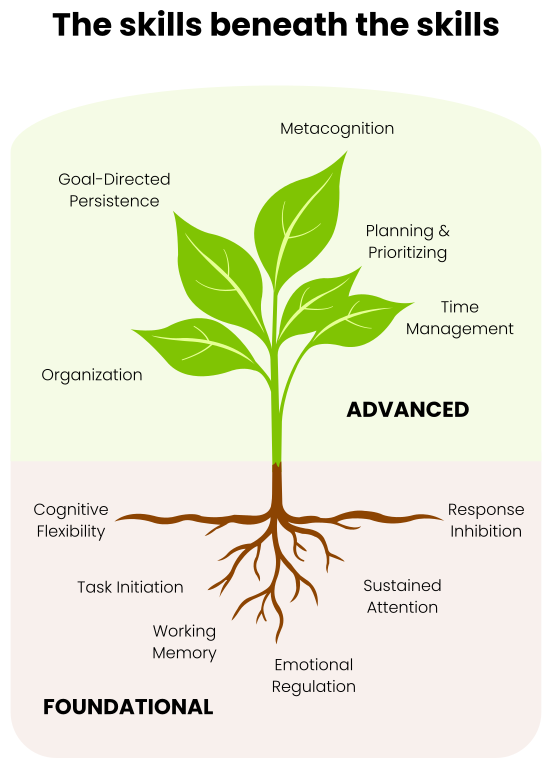
My work on executive function follows the framework developed by Drs. Peg Dawson and Richard Guare, best known from their book Smart but Scattered and detailed on their website. They describe eleven skills, split into two groups.
Foundational skills emerge earlier in executive function development and everything else is built on top of them:
- Response inhibition, or impulse control: thinking before acting
- Working memory: holding information in your mind while using it
- Emotional regulation: managing distressing feelings well enough to keep working
- Cognitive flexibility: adapting when conditions or plans change
- Sustained attention, or directed attention: staying with a task through boredom or distraction
- Task initiation: beginning without excessive delay
Advanced skills develop later, take longer to mature, and depend on the foundational ones being available:
- Planning and prioritizing: knowing the order of steps and deciding which tasks are most important
- Organization: keeping track of materials and information
- Time management: estimating and allocating time realistically
- Goal-directed persistence: sticking with a goal that will pay off later
- Metacognition, or self-monitoring: watching your own thinking, catching your own errors, and reflecting on how to improve
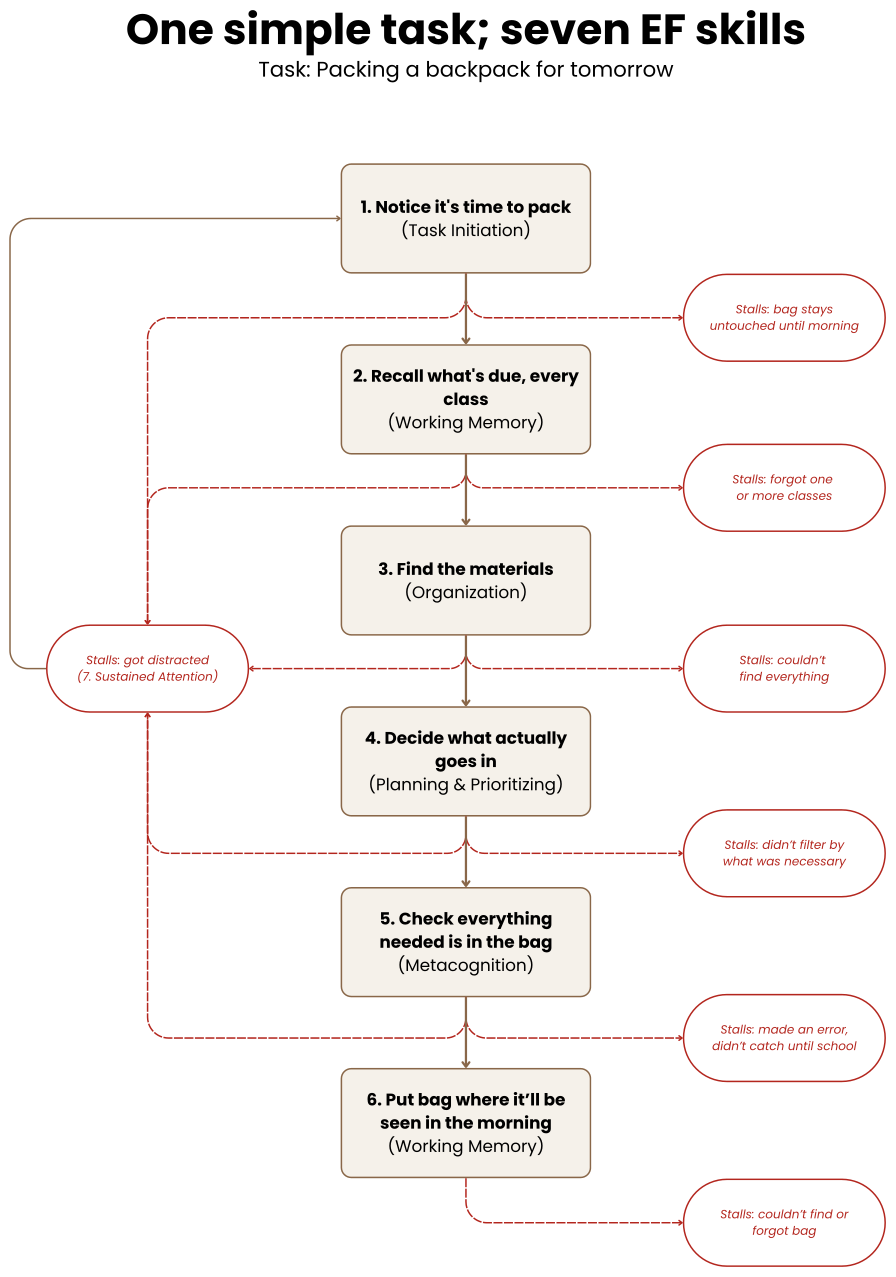
The split between foundational and advanced skills explains a problem with existing EF supports. When I was in fifth grade, our school gave us all free planners, but almost no one ever used them. That's because planners support advanced skills (organization, planning, prioritization, time management). It's not useful to a kid whose actual problem is task initiation, a foundational skill: opening the planner is itself a task that has to be initiated first. You can't scaffold skill #7 for a kid who's still working on skill #1.
Where executive function challenges arise
If you or someone in your family has ADHD, you've probably heard a lot of these terms. Many people diagnosed with ADHD will be referred to a specialist for executive function coaching, or learn executive function strategies in therapy, because executive dysfunction is at the core of most ADHD challenges. The difficulty is real, measurable, and isn't changed by sheer willpower. Students with autism spectrum disorder (ASD) also face EF challenges, but the main difference is that these difficulties are context-dependent. For example, autistic people might report difficulty sustaining attention in a subject they dislike, but have no trouble fixating on one that interests them; or they could have trouble starting tasks, but only because the directions weren't clear.
But this is not exclusively an ADHD problem, or an autism problem, or a problem belonging to whichever students have a medical diagnosis. Most people will never hear the term "executive function." And yet, across research studies and the people I work with directly, I repeatedly see students expected to perform advanced EF tasks without being equipped with the supports to do so.
The prefrontal cortex is the region of the brain where most EFs occur. It's also among the last regions of the brain to finish maturing, continuing to develop into your twenties, and, by some recent estimates, into your thirties. You've probably heard people say "the brain doesn't finish developing until around age 25." The reality of that claim doesn't reflect such a tidy number, but the statement correctly correlates maturity with advanced EF processes involved in decision-making. It's part of why we don't let people rent cars until 25 and why auto insurance stays expensive for teens and people in their early twenties: impulse control under emotionally charged conditions is one of the latest-developing pieces of this system.
Obviously, schoolwork doesn't involve a level of danger that invokes the law. But for the entire span of a person's schooling, from the first day of kindergarten through the last exam of senior year, these critical neural systems aren't at full capacity. Every student is being asked to plan, prioritize, self-monitor, and manage frustration with equipment still under construction. A diagnosis may explain the degree or shape of EF challenges, but it is not the only source of them.
This is the water every student is swimming in. We hand an eleven-year-old a long-term project with no checkpoints and expect them to complete it independently. We give a fifteen-year-old six teachers, six subjects, and six deadlines and expect them to build the full schedule all on their own.
Improving executive functions with strategies
The good news is that EF skills are teachable. However, I'd like to be careful about what "improving EF" means, because two different methods exist, and people use this same phrase to describe them.
One is process training: brain-training games and apps, usually targeting working memory directly, on the idea that repeated practice on the underlying task will expand the capacity to remember information. The evidence for this doesn't hold up when applied to tasks outside of the training game, and the long-term benefits are unclear. Even a federally published review of the field concludes that evidence for these gains carrying over to real academic outcomes is "mixed at best." A student can get very good at a memory game without that translating into remembering their own multi-step homework instructions.
The other is compensatory strategy instruction: not expanding a limited capacity, but teaching a workaround that gets the job done despite the limit. This is already the backbone of most ADHD treatment, and it's the better-supported approach of the two. It incorporates visual cues, checklists, digital tools, and structured coaching, designed to offload what a strained working memory or attention system can't reliably hold on its own.
This is the strategy I use, and it comes from personal experience. I was the student labeled careless in math. I'd forget to regroup when subtracting, or make minor calculation errors. Wrong answers got circled, I fixed them, and that was the whole intervention. People around me seemed frustrated that these were the kinds of mistakes I was making — understandably, since if they were due to a lack of conceptual understanding, they would have known how to prevent them. What was happening was that I skipped steps and held too much in my head at once, leaning on working memory that could not carry that load. Nobody around me had a name for it, so it looked like carelessness.
I no longer ask my working memory to hold a single step of a math problem. I externalize all of it, writing down and visualizing every stage, no matter how small. It sounds like extra steps and seems inefficient, but this is where the self-correction lives. I catch my own mistakes while they are still steps instead of after they've become wrong answers. If anything, it's actually a time saver, because I make fewer mistakes and locate failure points quickly. This is the same strategy I recommend to every student, since a skipped step is usually where a calculation error happens. Accurately framing the problem as a performance gap instead of a knowledge gap is what brings a student one step closer to their goal.
Implications for education
For a child arriving at school, a solid base of these foundational skills matters more than whether they already know their letters and numbers. EF consistently predicts academic outcomes as well as, and often better than, IQ. The National Center for Education Research has published a thorough paper on EF's potential to enhance academic learning, which calls for a heavier focus on EF research in education policy.
There's a structural reason that call hasn't been answered yet; school is organized by subject, so there's no dedicated class period for EF. To be fair, EF doesn't need its own class period. Some educators are already showing how EF instruction can be woven directly into existing subjects: a math teacher building working-memory scaffolds into word problems, a writing unit doubling as planning practice (read detailed examples for each discipline). The strategies have been outlined, but haven't been widely implemented. Whether any given student encounters them depends on whether their teacher happens to have found this guide, versus it being a built-in expectation of the curriculum. Each teacher barely has forty-five minutes to cover the content outlined by state standards, let alone create and find time to teach a parallel EF curriculum on their own.
Waiting for policy and curriculum design to catch up could take years or decades. Until schools restructure around this (and there's no guarantee they will, or on what timeline), EF strategies need to be taught deliberately and explicitly by the adults already closest to the student: parents, tutors, therapists, and any educator willing to treat it as its own discipline instead of an assumed prerequisite.
That's the premise behind my own work at Foundations First. Executive function coaching is valuable, but general EF strategies are only half the picture for students. Applying them to specific subject-level contexts gives them the proper support currently missing from academic instruction: visual scaffolding for how one paragraph's argument flows to the next, or error analysis to self-check a multi-step math solution before it gets turned in. A brain that's still developing deserves strategies that meaningfully relate to problem-solving in the classroom, from the first assignment to the last.
Further reading
There are two threads here I'm leaving for future posts. ADHD's relationship to executive function is more complicated than the summary above suggests, and there's an argument that executive dysfunction isn't just a feature of ADHD, but what ADHD actually is; I'll get into that in a future post. Each of these eleven skills also deserve their own treatment. Those posts will link back here.
Sources
- Center on the Developing Child at Harvard University (2011). Building the Brain's "Air Traffic Control" System: How Early Experiences Shape the Development of Executive Function, Working Paper No. 11. Read the paper
- Arnsten, A. F. T. (2009). Stress signalling pathways that impair prefrontal cortex structure and function. Nature Reviews Neuroscience, 10(6). Read the paper
- Dawson, P. & Guare, R. Smart but Scattered. Framework and skill definitions at smartbutscatteredkids.com
- Willcutt, E. G. et al. (2005). Validity of the executive function theory of attention-deficit/hyperactivity disorder: a meta-analytic review. Biological Psychiatry, 57(11). Read the abstract
- Kenny, L., Remington, A., & Pellicano, E. (2024). Everyday executive function issues from the perspectives of autistic adolescents and their parents: theoretical and empirical implications. Autism. Read the study
- Gogtay, N. et al. (2004). Dynamic mapping of human cortical development during childhood through early adulthood. PNAS, 101(21). Read the paper
- Mousley, D. et al. (2025). Topological turning points across the human lifespan. Nature Communications, 16, 10055. Read the paper
- Steinberg, L. (2008). A social neuroscience perspective on adolescent risk-taking. Developmental Review, 28(1). Read the paper
- Zelazo, P. D., Blair, C. B., & Willoughby, M. T. (2016). Executive Function: Implications for Education (NCER 2017-2000). National Center for Education Research, Institute of Education Sciences. Read the report
- Dawson, P. & Guare, R. (2018). Executive Skills in Children and Adolescents: A Practical Guide to Assessment and Intervention (3rd ed.). Guilford Press. View the book
- Diamond, A. (2013). Executive functions. Annual Review of Psychology, 64. Read the review
- Inclusiveteach.com (2025). Building Executive Function Skills Across the Curriculum: Subject-Specific Strategies. Read the article